minicabit vs Uber: Which is Best for UK Taxi Booking in 2026?
At a Glance
- minicabit is a UK-focused taxi comparison platform aggregating fixed-price quotes from 1,000+ licensed Private Hire Operators across 550+ UK towns and cities, with a website and mobile app for booking
- Uber is a global ride-hailing app currently licensed in approximately 28 UK cities, using dynamic surge pricing with drivers allocated at the time of request
- minicabit is the only one of the two with fixed pricing locked at booking, no surge fees, Meet and Greet inside the terminal, and coverage that extends to 550+ UK towns and cities
- For airport transfers, advance bookings, group travel, festivals, long-distance journeys, and anywhere outside major UK cities, minicabit offers advantages over Uber and other ride-hailing apps
- For short on-demand urban rides, minicabit is also competitive – the comparison technology returns live quotes from local licensed operators, often beating ride-hailing apps on price once surge multipliers kick in
- Uber’s UK pricing has risen substantially since 2021, with documented increases of 10% across London, 25% on peak-time airport routes, and a further 5% UK-wide in 2023
- This comparison is current as of May 2026. Named competitors are referenced under nominative fair-use convention
Quick Verdict: Which Taxi App is Best in the UK?
Both platforms work, and both are legal, licensed Private Hire services regulated by Transport for London or equivalent local councils. The honest answer to “which is best” is that the right tool depends on the journey – but for most journeys that UK travellers actually take, minicabit’s comparison technology delivers better value, more reliability, and dramatically wider coverage than Uber.
For airport transfers, advance bookings, group travel, long-distance journeys, and anywhere outside major UK cities, minicabit is the clear choice – and it’s the only one of the two with fixed pricing, including Meet and Greet inside terminals, automatic flight tracking, and 45 minutes’ free waiting time at airports, and 15 minutes’ free waiting time everywhere else. For short, on-demand urban rides, minicabit is competitive too: the platform returns live quotes from local licensed Private Hire Operators, and because there’s no surge multiplier, those quotes increasingly undercut Uber and other ride-hailing apps for the same journey.
This guide walks through the comparison in detail, with sources, so you can choose the right tool for whatever journey you’re booking next. While Uber is the focus of this comparison as minicabit’s most direct UK competitor, broader points about ride-hailing apps apply to other apps in the same category, including Bolt.
How minicabit and Uber Each Work: Two Different Booking Models
Before comparing features, it’s worth understanding that these two platforms operate on fundamentally different commercial models.
minicabit is a comparison technology platform. It does not own vehicles or employ drivers. Instead, it aggregates real-time quotes from 1,000+ licensed Private Hire Operators across the UK and lets you compare and book a fixed-price ride directly with the operator of your choice. Bookings can be made via the minicabit website or mobile app. The model is similar to comparison sites in flights or insurance: minicabit’s job is to surface the best available option for your specific journey from a network of local licensed operators.
minicabit was born and grown in the UK and is built around Britain’s network of local licensed Private Hire Operators. Rather than replacing local cab firms with a single national fleet, the platform helps customers compare quotes from established local Operators who already know their area, their airports, and their regular routes.
Uber is a ride-hailing platform with a directly-sourced driver network. In the UK, Uber operates as a licensed Private Hire Vehicle (PHV) operator in approximately 28 cities, with drivers signed up as self-employed contractors. Pricing is dynamic – a base rate, cost per minute, and cost per mile, multiplied by a surge factor when demand is high. Drivers are allocated algorithmically at the time of your booking request, not in advance. (Source: Startups.co.uk UK Uber Locations Report, March 2026).
There is also a commercial difference in how prices are created. Uber’s model is based around app-set fares and driver payments. With minicabit, local Cab Operators set their own quotes for each journey, with any minicabit fee included in the overall price shown to the customer. That means the fare is shaped by local Operators competing for the booking, rather than by a single dynamic-pricing platform.
Other ride-hailing apps available in some UK cities, including Bolt, operate on similar dynamic-pricing models with drivers allocated at the time of request.
A note on Uber’s UK licensing history
Transport for London revoked Uber’s London licence in 2017 and again in 2019, with Uber operating under conditional licences since restoration. Both decisions were the subject of legal challenge and significant media coverage at the time, and the operating model has been subject to ongoing scrutiny. (Source: BBC News).
Uber currently operates legally under Transport for London oversight, but the institutional history is a useful indicator of structural risk when choosing a long-term provider. minicabit’s aggregator model has no equivalent licensing exposure – each Private Hire Operator on the platform holds their own local licence from their local council, regulated under standard PHV rules. minicabit itself has operated continuously since 2012 without any licensing interruption.
UK Coverage Compared: minicabit’s 550+ Town Network vs Uber’s 28 Cities
This is where the gap between minicabit and the ride-hailing apps is largest, and where it matters most for the journeys most people actually book.
minicabit covers 550+ UK towns and cities, with 99% of UK railway stations and 95% of major UK airports included. The aggregator model means coverage extends well beyond the major urban centres into market towns, commuter belts, rural villages, and any postcode where a licensed Private Hire Operator can pick you up.
Uber operates officially in approximately 28 UK cities as of March 2026: London, Manchester, Birmingham, Leeds, Liverpool, Bristol, Sheffield, Newcastle, Edinburgh, Glasgow, Aberdeen, Dundee, Cardiff, Belfast, Cambridge, Brighton, Portsmouth, Oxford, York, Hull, Nottingham, Plymouth, Swansea, Darlington, Tunbridge Wells, Lancaster, Lincoln, and Wiltshire. Uber used to run a “Local Cab” feature in some additional towns by partnering with local fleets – though this was controversially axed, with some councils questioning its legal basis. (Source: Startups.co.uk, March 2026; Taxi-point, March 2025). Following on from this, in many of these towns, Uber started its own operations, directly in competition against its former local fleet partners.
That works out to minicabit covering roughly twenty times more UK locations than Uber. For anyone needing a taxi in Bedford, Canterbury, Reading, Carlisle, Torquay, parts of Wales, the Lake District, the Highlands, or thousands of other UK towns, Uber and other ride-hailing apps simply do not reliably operate. minicabit aggregates local licensed operators who know their area and can complete the journey.
This matters most for airport journeys that start outside large city centres. If you are travelling from a rural home, village, commuter town, business park or university campus to a UK airport, ride-hailing apps may not have reliable local driver supply – particularly for pre-booked early morning trips. minicabit’s model is better suited to these journeys because it can surface licensed Cab Operators based near the pickup, destination or route, rather than relying only on app-driver availability in the immediate pickup area.
This is the strongest single argument for using minicabit as a default rather than as a backup: it works wherever you need it.
Fixed Pricing vs Surge Pricing: How the Two Platforms Charge
The pricing models could not be more different, and the practical impact on what you actually pay is significant.
How minicabit’s fixed pricing works
When you book through minicabit, the fare you see at booking is the fare you pay. The price is locked at the moment of booking and does not change regardless of:
- Demand on the day (no surge pricing applied)
- Traffic delays on the route
- Flight delays at airports
- The time of day or day of week
- Airport drop-off and access charges (these are included in the fare)
Because the quote comes from a licensed Cab Operator and is locked in when you book, the minicabit price is not recalculated around short-term spikes in demand. The customer sees one overall price, while the Operator remains in control of the quote they are prepared to offer for that route.
This applies to every booking, including journeys booked up to 12 months in advance. The price you lock in today is the price you pay in October. You can see worked examples of minicabit’s fixed-price model across the four main London airports in London Airport Taxi Costs Compared.
How Uber’s dynamic pricing works
Uber uses dynamic pricing. The base formula is a starting rate plus cost-per-minute and cost-per-mile, then multiplied by a surge factor when demand is high. In quiet periods, the price can be competitive. During peak demand windows – Friday and Saturday nights, bad weather, sporting events, music venues turning out, airport arrival waves, public transport disruptions – the surge factor can substantially increase the fare. Uber surges typically range from 1.5x to 2.5x or higher. (Sources: Uber Help; GM Direct Hire fare analysis, February 2026).
Uber operates a “Reserve” feature for scheduling rides in advance, but pricing can still adjust at the time the ride is dispatched.
Why Uber Has Become More Expensive in the UK
This is the part most comparison guides miss. Uber’s pricing has steadily risen in the UK over the past several years. The honest picture is that ride-hailing apps are no longer the budget option they were when they launched.
Documented Uber UK price rises since 2021
- November 2021: Uber raised London fares by 10% across the board, with peak-time airport journeys to Heathrow, Gatwick, Luton and Stansted increasing by 25%. Described at the time as Uber’s first significant London price increase since 2017. (Source: BBC News).
- December 2023: Uber announced a further 5% increase to UK base fares “to attract more drivers”. (Source: Telecoms.com).
- January 2026: Uber raised its Central London Fee from £1.50 to £2.00 per eligible trip. (Source: WeFlex, January 2026).
What this means for the comparison
The cumulative effect of these changes – a 10% London fare rise in 2021, a 25% airport surge increase, and a 5% UK-wide increase in 2023 – means Uber fares in 2026 are substantially higher than they were even two or three years ago. A central London Uber ride that cost £15 in 2021 might now cost £18-20 for the same route at the same time of day, before any surge multiplier is applied.
minicabit, by contrast, has not been affected in the same way. Because minicabit aggregates 1,000+ independent licensed operators rather than operating as a single national platform, fares are set competitively by individual local operators in each market. The comparison technology returns multiple quotes from Operators based near your pickup and destination locations, and the platform’s no-surge pricing means a booking is locked at the moment you confirm – not subject to demand or peak-time multipliers.
For travellers who remember Uber as the cheap option, the 2026 pricing reality is meaningfully different. Compare quotes side-by-side before assuming the ride-hailing app is the lower fare.
Why Airport Transfers are Where minicabit Stands Apart
**This is where minicabit’s product is most clearly differentiated. Airport pickups booked through minicabit include several features that Uber and other ride-hailing apps do not offer as standard.
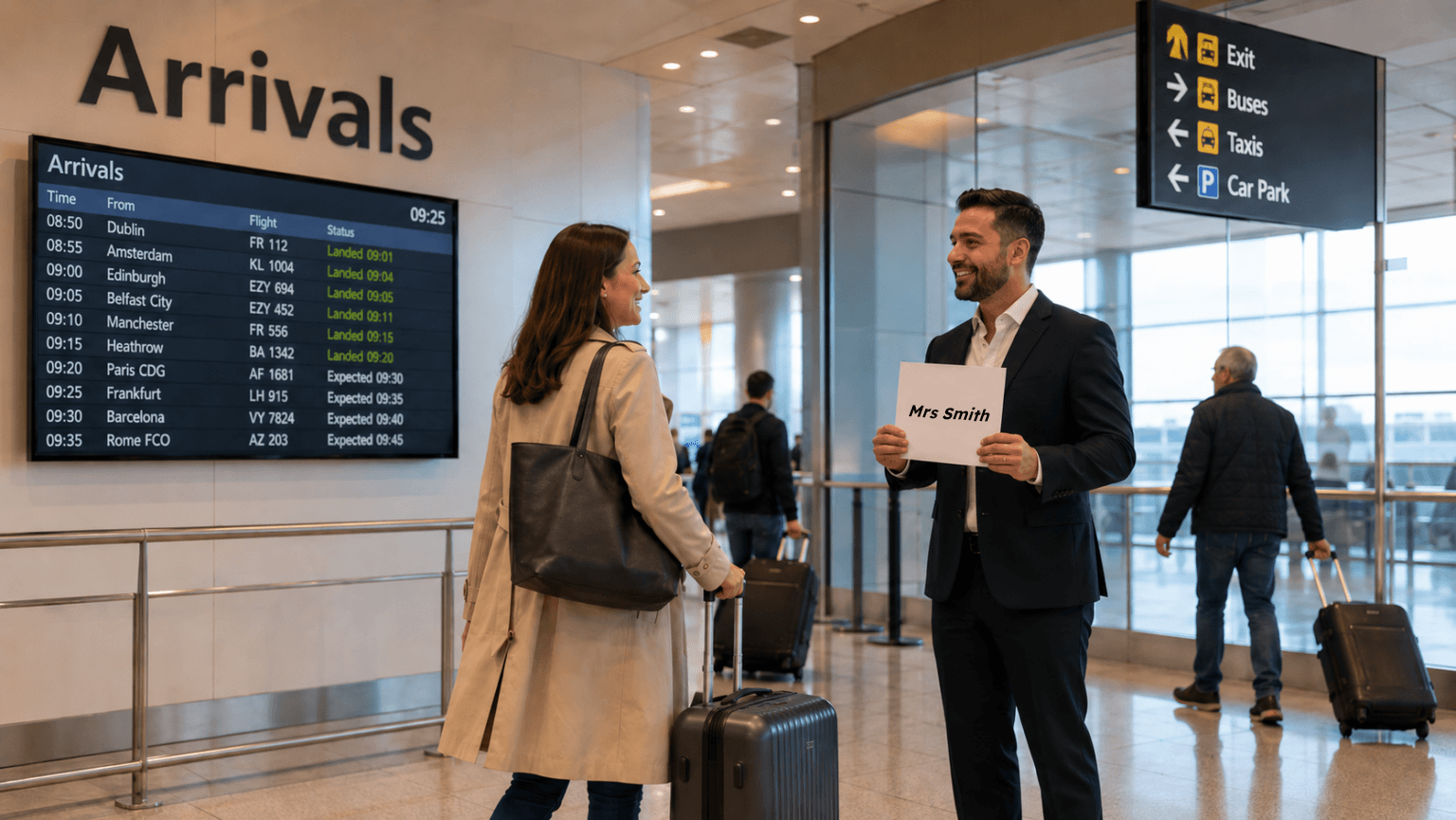
Meet and Greet inside the terminal. Your driver waits inside the Arrivals hall holding a name board. You do not need to find a pickup zone, navigate a car park, or stand outside on a curb. With Uber and other ride-hailing apps, you meet your driver outside in the forecourt, car park or designated pickup zone – the driver is allocated after you request the ride, so there is no name board and no terminal-side meeting.
Driver pre-assigned before you land. With minicabit, the driver is confirmed typically soon after booking – you receive their details by email and SMS in advance, and they are pre-assigned to your job. With Uber, the driver is allocated algorithmically at the moment you request the ride after landing.
Automatic flight tracking. minicabit’s Cab operators monitor your inbound flight in real time. If your flight is delayed or arrives early, the driver adjusts automatically. With Uber, you typically have to request the ride after you land – there is no automatic adjustment for delays.
45 minutes’ free waiting time from the actual landing time of your flight. If you are slow through immigration, baggage reclaim, or customs, the driver waits. With Uber, wait fees can begin within minutes of the driver arriving, and cancellation fees apply if you are slow through the terminal. Independent reporting confirms Uber drivers can cancel without penalty if passengers don’t appear within 5 minutes of arrival at the pickup zone – a real problem for arrivals where baggage claim takes 20-30 minutes. (Source: Mile5, April 2026).
Institutional credentials. minicabit is a trusted booking partner of Stansted Airport, Birmingham Airport as well as Booking.com and Expedia. This is the kind of institutional endorsement that doesn’t exist by accident.
For deep-dive pricing across the major UK airports, see our airport transfers hub and the individual airport pages for a taxi to Heathrow, taxi to Gatwick, taxi to Stansted, taxi to Luton, taxi to London City airport, and a taxi to Manchester airport.
Quick reference: minicabit Meet and Greet vs ride-hailing apps at airports
minicabit Meet and Greet (included, no extra fee):
- Driver pre-assigned and at the airport before you land
- Waiting inside the terminal at pre-set pickup points, such as the Information desk
- Holding a name board with your name
- Fixed price locked in at booking
- 45 mins’ free waiting time from your set pickup time, adjusted to 30 mins after your flight’s new landing time
Ride-hailing apps (surge applies):
- Driver allocated after you request from Arrivals
- Meet outside in the forecourt, car park or designated pickup zone
- Pin drop in pickup area, no name board, no name
- Surge pricing during peak landing windows
- Waiting fees if you’re slow through baggage reclaim
Group, Family and Accessible Travel: Vehicle Options Compared
Vehicle size is another structural difference. minicabit offers vehicles up to 8-seater MPVs and minibuses across the entire UK network, including wheelchair-accessible vehicles. This is part of the standard inventory at every airport and city.
Uber offers UberXL for groups up to 6 passengers – availability varies by city, and surge pricing applies to the larger vehicle category. Wheelchair-accessible vehicles via Uber are available in selected areas only.
For families travelling to an airport with a pushchair, travel cot, and four large suitcases, minicabit’s system works out that the right vehicle is an MPV or 8-seater – and minicabit enables that capacity to be available and bookable in advance, at a fixed price, with a luggage selector to confirm sizing. Child seats and booster seats can be requested at booking and supplied by the operator.
Pre-Booking and Reliability: Which Platform Wins for Advance Bookings?
For early morning flights, late-night arrivals, large events, or any journey where missing your transport has consequences, pre-booking reliability is the single most important feature.
minicabit: Book up to 12 months in advance. The competitive fixed price is locked at booking. The driver is pre-assigned. Free cancellation before the booking’s cut-off time (shown clearly with the booking). If ever the assigned fleet is not available last minute to fulfil the booking, minicabit can provide an alternative cab provider at no extra cost to you. This is the entire model – pre-booking is what the platform is built for.
Uber: The Reserve feature allows scheduling rides in advance in some but not all locations, yet surge pricing can still apply when the ride is dispatched, and cancellation fees apply with shorter notice windows. Drivers are not pre-assigned in advance – allocation still happens close to pickup time with drivers still able to reject a scheduled ride at the last minute, with no alternatives presented.
The difference is structural. With minicabit, an advance booking is a commitment from both sides – a specific operator commits to the job at a specific price, well in advance. With ride-hailing apps, an advance booking is essentially a request that will be matched closer to the time. For a 5am pickup to Heathrow in August, that distinction matters.
This is also why minicabit can be more competitive for pre-booked journeys. Local Cab Operators can price in advance for a confirmed job, while ride-hailing apps are more exposed to live demand, availability and dynamic pricing at the point of dispatch.
For more on why pre-booking consistently beats hailing or last-minute booking on price and reliability, see our guide to pre-booking vs flagging down a taxi.
Safety, Licensing and Driver Accountability Compared
Both platforms operate under Transport for London licensing in the Capital and equivalent local council licensing elsewhere. All drivers are DBS-checked, vehicles must meet PHV safety standards, and both platforms have customer complaint processes.
The structural difference is in accountability. minicabit’s aggregator model means you are booking with a licensed local Private Hire Operator – a company with an address, a phone number, an account manager, and a reputation built over years in a specific area. If something goes wrong, you are dealing with a named operator who is regulated by their local council and answerable for their service, backed up by minicabit’s own customer service. minicabit has operated continuously since 2012 without licensing interruption and is rated ‘Excellent’ on Trustpilot, with almost 9,500 customer reviews.
Uber operates a different model: drivers are self-employed contractors on the platform. The platform itself is the accountable entity. As noted earlier, Uber’s London licence has been revoked twice and restored under conditional terms – the institutional history is worth knowing when choosing a long-term provider.
For airport transfers, advance bookings, and high-stakes journeys, the local-operator accountability that minicabit’s model provides is the kind of safety net that matters when things go sideways.
When Each Platform Works: minicabit and Uber by Use Case
To be fair, both platforms have a place. Here’s the honest read of where each is genuinely competitive.
Short urban rides
For a quick hop across central London, Manchester, or another major city during off-peak hours, both platforms work. minicabit’s comparison technology returns live quotes from local licensed Private Hire Operators in that area, and because there is no surge multiplier, those quotes are increasingly competitive with – and often cheaper than – Uber for the same pre-booked journey. The minicabit app and website both support short pre-booked bookings, with bookings accepted from as little as 30 minutes’ notice. The cheap taxi choice for short urban rides typically comes down to comparing the live quote in front of you.
Airport transfers
minicabit is the clear choice. Meet and Greet, automatic flight tracking, 45 minutes’ free waiting time, drop-off charges included, fixed pricing. Uber requires you to walk to a pickup zone, arrange the ride yourself after landing, pay surge if it’s busy, and absorb wait fees if baggage reclaim is slow.
Advance bookings
minicabit is the clear choice. Up to 12 months ahead, fixed price guaranteed, driver pre-assigned, free cancellation. Uber’s “Reserve” feature doesn’t lock the price in the same way and is only available in certain locations.
Group and family travel
minicabit is the clear choice. 8-seater MPVs and minibuses available across the UK network with luggage capacity, child seats, and accessibility options. UberXL caps at 6 passengers and availability varies sharply by city.
Long-distance journeys
minicabit is the clear choice. Fixed-price model means no meter running through traffic or roadworks. Uber’s per-minute pricing makes longer journeys disproportionately expensive, especially in heavy traffic.
Festivals and major events
minicabit is the clear choice. Dedicated festival taxi booking service for Glastonbury, Latitude, TRNSMT, Wireless, Leeds Festival, and others – pre-booked, no surge. Uber operates on-demand only at festivals, with substantial surge multipliers during event peaks.
Travel outside major UK cities
minicabit is the only choice. 550+ towns and cities covered. Uber operates in approximately 28 UK cities. For anywhere else, you need the comparison technology that minicabit provides.
Business travel
minicabit is the clear choice for any business journey where cost certainty matters – fixed pricing, single invoice, expense-friendly, with the option for teams to book across the UK on one account.
Full Side-by-Side Comparison: minicabit vs Uber
| Feature | minicabit | Uber |
|---|---|---|
| Meet and Greet inside the terminal | Included. Driver with name board waiting for 45 minutes, typically at info desk | Not offered. Pickup zone only |
| Driver availability locked before you land at the airport | Yes. Pre-assigned after booking | No. Allocated just before pickup time |
| Price at peak landing times | Fixed. Locked in at booking, no surge | Surge applies. Dynamic pricing |
| Flight tracking and pickup adjustment | Automatic. Driver adjusts for early or late flights | No. Request after landing |
| Free waiting time on flight delays | 30 minutes from new landing time | Limited. Wait fees can apply |
| Pre-book in advance | Up to 12 months. Fixed price guaranteed | Reserve feature; surge can still apply |
| Up to 8-seater group taxis | Yes. Family/business groups | Up to 6 (UberXL). Limited availability |
| Wheelchair-accessible vehicles (WAV) | Available. Door-to-door assistance | Limited. Selected areas only |
| Free cancellation | Yes. Before driver dispatch | Conditional. Time-window dependent |
| UK towns and cities covered | 550+ | Approximately 28 cities |
| UK train stations | 99% coverage | Major cities only |
| UK airports | 95% of major airports | London and select cities |
| Airport drop-off charges | Included in fare | Passed to passenger |
| Licensed operator structure | 1,000+ licensed Private Hire Operators | Self-employed PCO drivers |
| Recent UK price rises | None (fixed-price comparison model) | 10% London (2021), 25% on airports (2021), 5% UK-wide (2023), Central London Fee rise (Jan 2026) |
| Trustpilot rating | 4.4 out of 5 (9,000+ reviews) | 1.7 out of 5 (35,000+ reviews) |
All claims comparison-current as of May 2026. Named competitors used per nominative fair-use convention.
Sources: Coverage data for Uber from Startups.co.uk UK Uber Locations Report (March 2026) and Uber UK city pages. Uber price rise data from BBC News, Telecoms.com, and WeFlex. minicabit data verified from minicabit.com and airport landing pages, May 2026.
Frequently Asked Questions
Is minicabit cheaper than Uber? For airport transfers, advance bookings, group travel, long-distance journeys, and any ride outside major UK cities, minicabit is consistently more predictable and frequently cheaper than the dynamic-pricing alternatives. For short pre-booked rides in urban areas, minicabit is competitive – the comparison technology returns live quotes from local licensed operators, and because there’s no surge multiplier, those quotes increasingly undercut Uber for the same journey. Uber’s UK fares have risen substantially since 2021.
Has Uber become more expensive in the UK? Yes. Uber raised UK fares by 10% across London in November 2021, with peak-time airport routes rising by 25%. A further 5% UK-wide increase followed in December 2023. Uber also raised its Central London Fee from £1.50 to £2.00 in January 2026. (Sources: BBC News, Telecoms.com, WeFlex).
Does minicabit cover the same UK cities as Uber? minicabit covers significantly more UK locations than Uber or other ride-hailing apps. minicabit serves 550+ UK towns and cities through its network of 1,000+ licensed Private Hire Operators. Uber is officially licensed in approximately 28 UK cities. For anyone needing a taxi outside the major urban centres, minicabit is the only reliable option of the two.
Is the Meet and Greet service really included with minicabit? Yes. Meet and Greet is included as standard on every airport booking through minicabit. The driver waits inside the terminal with a name board, typically at the Information desk. 45 minutes’ free waiting time is included, or 30 minutes’ from any updated landing time of your flight. Uber does not offer an equivalent service.
Can I book minicabit for a short ride or just for airport journeys? Both. minicabit can be used for any UK journey, including short urban rides, daily commutes, and last-minute bookings (from 30 minutes’ notice). The platform is most distinctive for airport, long-distance, and advance bookings, but the comparison technology returns competitive quotes for short urban rides too, and bookings can be made via the minicabit website or mobile app.
Can I pre-book Uber in advance like minicabit? Uber offers an advanced scheduling feature called Reserve in some but not all locations, yet pricing on these bookings can still adjust at the time the ride is dispatched, and the driver is not pre-assigned. With minicabit, advance bookings are at a fixed price, with the driver pre-assigned, up to 12 months ahead, with alternative providers lined up to fulfil the trip at no cost to you. Free cancellation is available before the cancellation cut-off time shown at booking.
Are airport drop-off charges included in minicabit fares? Yes. All UK airport drop-off and access charges are included in the minicabit fare. There is nothing extra to pay at the airport.
Is minicabit safe? Yes. Every Private Hire Operator on minicabit is independently licensed by their local council, with the Operator licence requiring DBS-checked drivers and inspected vehicles meeting PHV safety standards. The aggregator model means you are booking directly with a licensed local operator who is accountable to their local council. minicabit has operated continuously since 2012 without any licensing interruption, and is rated 4.4 out of 5 on Trustpilot from over 9,000 verified reviews.
Can I use minicabit for festivals like Glastonbury? Yes. minicabit operates a dedicated festival taxi booking service covering major UK festivals including Glastonbury, Leeds Festival, TRNSMT, Latitude, Wireless, and Wilderness. You can pre-book up to 12 months in advance at a fixed price, with no surge pricing at the event itself. Uber operates on-demand only at festivals (if available there), with substantial surge pricing during event peaks.
About minicabit
minicabit is the UK’s largest online taxi comparison platform, founded in 2012 and now part of the CMAC Group, the international ground transport specialist. Originally born and grown in the UK, minicabit continues to support Britain’s local licensed Cab Operators by helping them compete for online bookings across airport transfers, regional journeys, business travel and everyday taxi trips.
The platform connects travellers with over 1,000 licensed Private Hire Operators across 550+ UK towns and cities, covering 95% of major UK airports and 99% of UK railway stations. minicabit was the first taxi app to win investment on BBC TV’s Dragons’ Den, has been named “Best Ground Transport” four times at the Travolution Awards, and partners with Booking.com, Stansted Airport, Birmingham Airport, and Expedia. The platform is rated 4.4 out of 5 on Trustpilot from over 9,000 verified customer reviews.
This guide was written by the minicabit editorial team and is reviewed and updated regularly. Competitor data is sourced from independent publications and official company pages, and is cited inline. Named competitors are referenced under nominative fair-use convention.
Have a question about UK taxi booking not covered here? Contact minicabit at info@minicabit.com or call +44 1322 251 351.
Compare Quotes and Book Your Next UK Taxi
For airport transfers, advance bookings, group travel, short urban rides, or any UK journey across 550+ towns and cities, compare fixed-price quotes from over 1,000 licensed Private Hire Operators at minicabit.com.
Book online: minicabit.com | Phone: +44 1322 251 351 | Email: info@minicabit.com
Author Information
Written by minicabit, with contributions from Amer Hasan, MD of minicabit. minicabit has been comparing UK cab fares for over 14 years and works with 1,000+ licensed Private Hire Operators across the UK.
External sources
- BBC News – Uber London 10% / 25% airport fare rises (2021); Uber UK licensing history
- Telecoms.com – Uber UK 5% fare rise (Dec 2023)
- WeFlex – Uber Central London Fee increase £1.50 to £2.00 (Jan 2026)
- Mile5 – 47-booking observable fare comparison and Uber pickup cancellation reporting (April 2026)
- Startups.co.uk – Uber UK city licensing list (March 2026)
- Taxi-point – Uber Local Cab controversy context (March 2025)
- GM Direct Hire – Uber surge multiplier analysis (Feb 2026)